
By Ben Gerstein
I arrived in Srebrenica amidst flurries on a Sunday afternoon. The town, and the neighboring village of Potočari which hosts the Srebrenica Memorial Center, is notoriously quiet in the winter months. I have been living in Bosnia and Herzegovina since September 2025, primarily researching criminal law’s capacity to marginalize genocidal ideologies and respond to post-atrocity mnemonic harms like genocide denial. This work brought me to Srebrenica for the week.
On my first day, two incredibly generous and knowledgeable staff members at the Memorial Center kindly offered to accompany me on a drive to visit many of Eastern Bosnia’s sites of atrocity. While the genocide in Srebrenica is associated most intimately with the town, the physical infrastructure of the violence—its execution sites and mass graves—stretch across much of the surrounding area known as Podrinje. The absence of memorialization present at these sites, located in the Bosnian Serb entity of Republika Srpska, speaks to international criminal law’s limited ability to prevent the erasure of the adjudicated past. I was curious to see how these locations of such tragedy are seamlessly and eerily integrated into the everyday life of the region’s inhabitants.
I was curious to see how these locations of such tragedy are seamlessly and eerily integrated into the everyday life of the region’s inhabitants.
We began our day with a discussion of the “Death March” or “column” at the Memorial Center. After Srebrenica fell to General Ratko Mladić and the Army of Republika Srpksa (VRS), thousands of Bosniak men organized an escape to the free territory of Tuzla where the Army of the Republic of Bosnia and Herzegovina (ARBiH) was in control. This treacherous journey on foot from Srebrenica through the mountains of Eastern Bosnia became known as the “Death March.” At various points, those navigating the densely wooded and elevated landscape came under intense fire from Bosnian Serb forces. Many of those fleeing Srebrenica were eventually killed, and more than a thousand others were captured and later systematically executed. Throughout the day, we planned on tracing some of the column’s movement and visiting many of the locations where those captured were taken and murdered, often by firing squads of soldiers and paramilitary units.
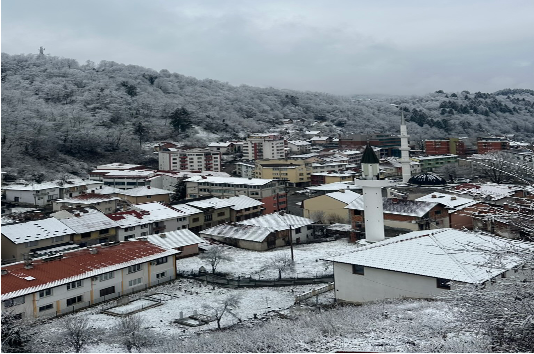
Before setting off for the town of Bratunac, our first stop, we drove into Srebrenica from Potočari. Today, Srebrenica is populated by a few thousand Bosniak returnees and Serbs. The snow from Sunday, which would soon melt, still blanketed the town and the tree-dense mountains.
Bratunac is the largest town in the area, about 10 kilometers from Srebrenica. While the Srebrenica enclave is most known for being the site of genocide in 1995, the Podrinje region was host to significant crimes against civilians beginning in 1992. At the war’s onset, a violent displacement campaign was conducted across Eastern Bosnia. Bosnian Muslims were forced out of their homes by a collection of Serbian and Bosnian Serb military and paramilitary forces, who relied on highly coordinated campaigns of terror. Killings, mass rapes, and other modes of brutality were the technologies of the moment.
In Bratunac, our first stop was at one of the main locations where 1992-era atrocities in Podrinje took place: the Vuk Karadžić School. It is estimated that 300 of the 800 detained in the school, which my guides described as a concentration camp, were eventually killed by Serbian paramilitary forces. Interviews with the Balkan Investigative Reporting Network revealed the particularly dire conditions inside the building’s gymnasium. “It was horribly crowded and hot. Ten people suffocated to death due to panic and the lack of air on the first day. After that, the awful beatings and killings began,” one survivor shared.
School was in session and I watched children, probably as young as seven or eight-years old, stream in and out of the building. We did not exit the car. Instead, we parked on the side of the road with our hazard lights on for about two or three minutes. My mind leapt to thinking about what it would mean to spend my formative years of elementary schooling in a former detention center where civilians were executed. I wondered if those students knew anything of the building’s tragic past. Their teachers and parents surely must remember, or in some ways passively know.
Primo Levi, the chemist, author, and survivor of Auschwitz, said that ‘monsters exist, but they are too few in numbers to be truly dangerous. More dangerous are…the functionaries ready to believe and act without asking questions.’ What is communicated about this building’s history? What questions are asked in return? What is ultimately believed? Do the quotidian motions of a day at school permit an encounter with the past? What can be expected of children this young?
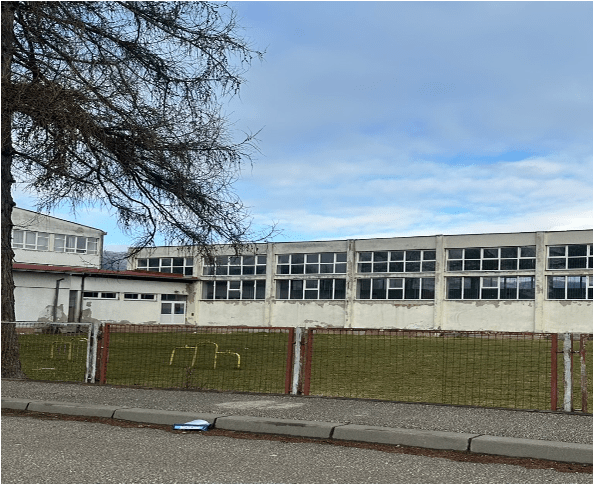
As we pulled away, a large cross made of fresh wood came into view. It stood isolated in the middle of the school’s athletic field. I was told this was common—crosses mark places of Serb suffering during the war (and of course many Serb civilians were victims of crimes during the 1992-1995 war in Bosnia) as a means to erase or neglect recognizing crimes committed against Bosniaks. The cross captures the essence of monopolies of victimhood, so omnipresent in the Balkans and elsewhere: one’s victimhood transforms into a shield, deflecting any possibility that they, too, could be a perpetrator.
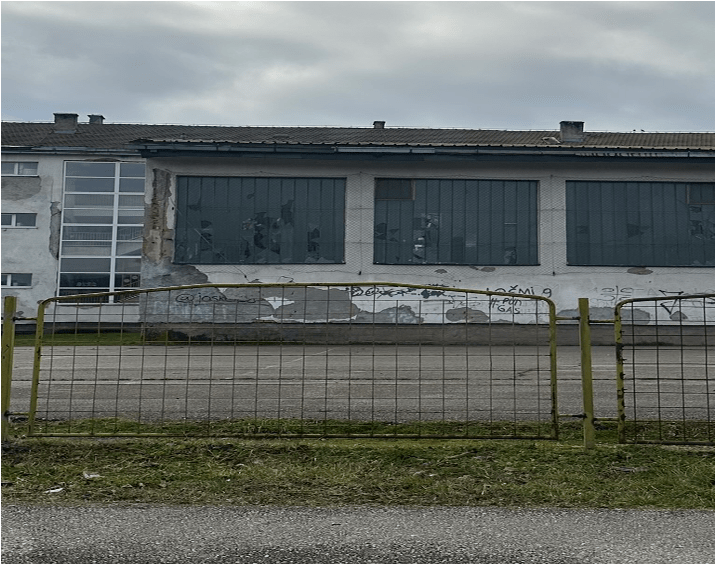
On the way to our next destination, we drove by another school located in the town center of Bratunac. A seemingly abandoned and desolate structure—marked by its shattered glass-paneled windows and worn exterior—was pointed out as another school used to detain and eventually kill Bosniak victims. However, unlike the other school, this structure was only enlisted in the 1995 genocide, according to victim testimony at the International Criminal Tribunal for the Former Yugoslavia (ICTY), housing Bosniak men who had been gathered and bussed from nearby Potočari. Neither school possessed any semblance of a memorial or monument documenting the atrocities which occurred therein.
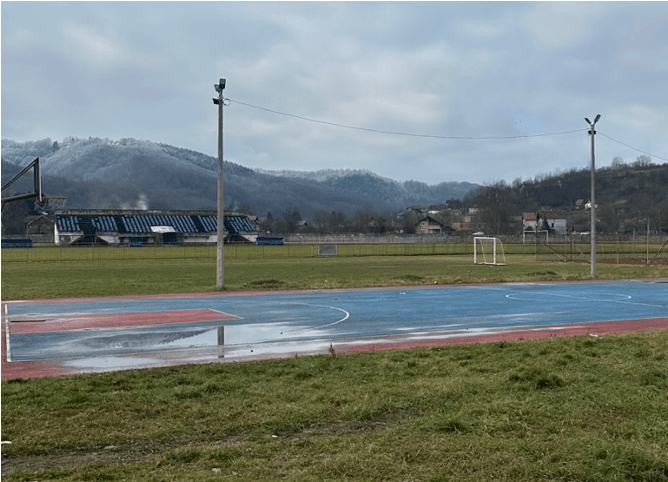
Two turns and one minute later we arrived at the main football field in Bratunac. When the offensive in Eastern Bosnia began in 1992, the stadium was quickly enlisted as a prominent logistical site for Serbian forces of the Yugoslav People’s Army (JNA). Here, thousands of Bosniaks were gathered from the surrounding villages. Forced removal operations resulted in masses of Bosnian Muslims newly displaced from their homes. At the field, men were separated and then relocated to detention camps, like our first stop: the Vuk Karadžić Primary School. In 1995, the pitch was once again deployed as a means to organize Bosniaks and distribute men to various slaughter sites. Currently, the stadium is home to the regional club FK Bratstvo Bratunac. When we arrived, the field was empty though life carried on in the neighboring collection of homes, apartments, bars, and cafes.
Having seen the main sites of Bratunac, we set off to trace the mechanics of the Srebrenica genocide. This component of our journey would have us visit killing houses where men—either taken in Srebrenica or captured along the refugee column—were brought and gunned down systematically. We also planned to visit key sites along the column where Bosnian Serb units attacked those fleeing for safety, and the primary, secondary, and tertiary mass graves enlisted by perpetrators to conceal evidence of their crimes.
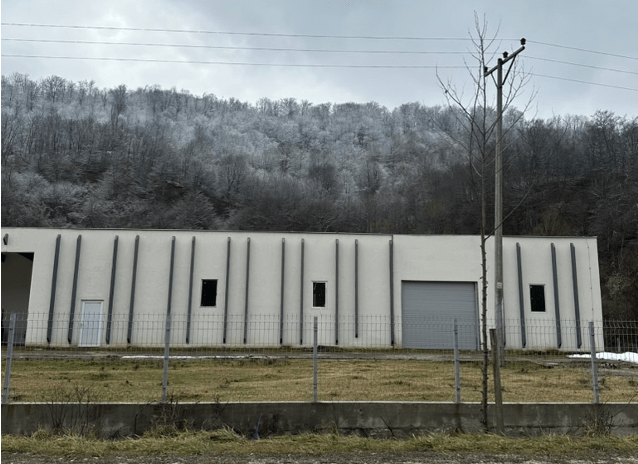
As we turned onto R454, the road between Bratunac and Konjević Polje where a majority of men were captured during the genocide, the relative flatlands of Bratunac gave way to a narrow canyon, where the mountains gradually hugged the road from both sides. Eastern Bosnia is sparsely populated, with unencumbered nature dominating the landscape. On the road towards Kravica—one of the villages on the outskirts of Bratunac—few structures are visible. After about twenty minutes of driving, we came across an abandoned warehouse. The warehouse was guarded by a derelict fence. Its front façade was seemingly renovated, though older, more dilapidated structures sat behind the main building.
This was the Kravica Warehouse, a former agricultural facility where more than 1,000 men were executed on July 13, 1995. Those killed here were captured on the trek out of Srebrenica. Men were herded into the warehouse. Soldiers then threw grenades inside and shot indiscriminately. One survivor testified that “he covered himself with two dead bodies” to avoid being detected. “The witness went on to claim that at one moment he heard an order from the soldiers for the cement floor to be washed and then for the dead bodies to be covered with hay.”
Presently, nothing marks the Kravica Warehouse as a site of genocidal violence. Entrance to the property is not permitted, but a close glance at the doorposts reveals remnants of bullet holes from the executions. Today, the local Bosnian Serb-run government of Srebrenica hopes to transform the warehouse into an “entrepreneurial hub.”
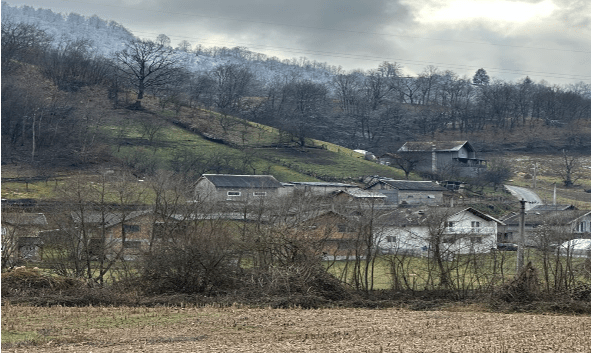
Following Kravica, we visited two nearby sites along the route of the escapees who fled Srebrenica for areas controlled by the Army of Bosnia and Herzegovina. At the first location, pictured below, large electric wires hang over the mountains, fields, and homes. My two guides pointed out that these wires helped guide those traversing the mountains to the free territories. Across the road from this viewpoint, and not pictured here, a famous ambush of the “Death March” occurred. Recorded on video, Ramo Osmanović was forced by Bosnian Serb soldiers to call for his son, Nermin, and others to exit the woods, climb down from the mountains, and surrender. The bodies of both Ramo and Nermin were identified after excavations of a mass grave more than a decade later.
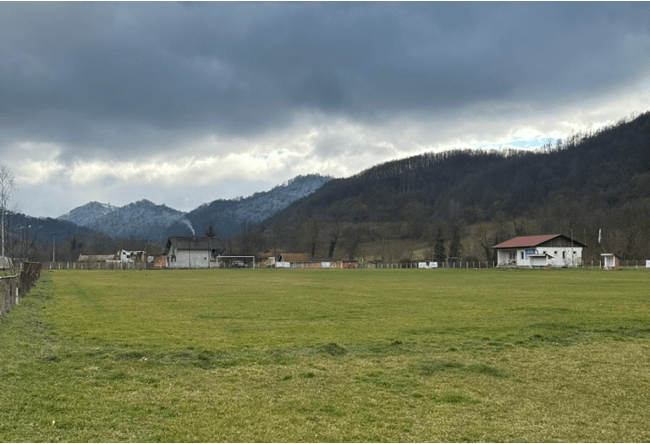
Our journey continued to Nova Kasaba. Unlike many villages in Eastern Bosnia, Nova Kasaba remains a majority Bosnian Muslim community. However, during the war, the lands of the village were used to facilitate the Srebrenica genocide. We pulled into the Nova Kasaba football field, which was relied upon (much like the football stadium in Bratunac) to gather and then distribute more than 1,500 men for slaughter and burial on July 13, 1995. Per the ICTY, “[m]ost of the men at Nova Kasaba were subsequently loaded into buses and trucks and taken to Bratunac and other holding sites.” Nova Kasaba was also itself a site of mass burial during the genocide, and my guides alluded to graves located near the river which ran towards the far end of the pitch.
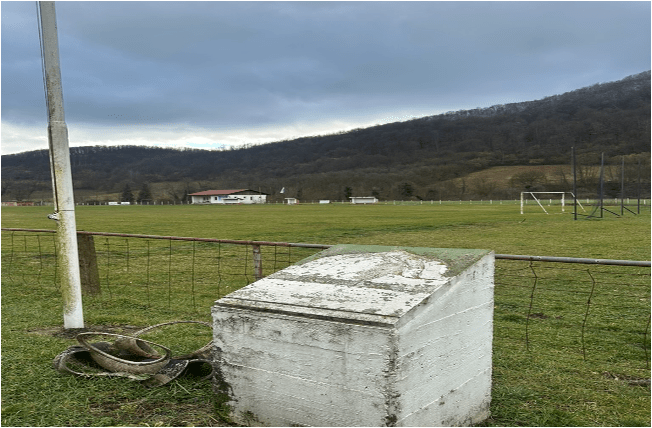
This site in Nova Kasaba was one of the only locations on our journey where a monument marked the crimes and honored its victims. The plaque is worn, simply stating the date of July 13, 1995 when the field was used by Bosnian Serb forces to detain Bosnian Muslims before their eventual killing.
Our departure from Nova Kasaba marked a shift away from a focus on the locations where initial captures of “Death March” participants took place. The remainder of our stops, instead, zeroed in on the more gruesome stages of the Srebrenica genocide: execution and burial.
As I drove us northward and then eastward towards the Drina, a river of stunning beauty which separates Serbia from Bosnia and Herzegovina, I was floored by the distance we had already traveled from Srebrenica. Over the span of a few days, victims were captured in mountainous areas around Srebrenica and then transferred to varied places in Eastern Bosnia. Disparate sites were deployed for killing and burial, with the ultimate aim of preventing the discovery of the mass murder of Bosniak men. In this way, Eastern Bosnia was transformed by the Bosnian Serb forces into a landscape of active erasure. The land itself—including both its natural vastness and mundane infrastructure—was relied upon to obscure the genocide’s violence. Today, it still does so.
The road eventually met the Drina River and took us through the border city of Zvornik. From there, we turned off the main road where a large factory marked the beginning of a series of villages that stretched westward from the water. We eventually arrived in Petkovci, with two stops planned at the Desanka Maksimović Primary School and the Petkovci Dam.
Our visit to Desanka Maksimović Primary School was brief. My guides suggested that we needed to be quick in examining the site and it would be unwise to get out of the vehicle. The school is operated by those still fervently committed to hiding its use as a detention and mass execution site during the genocide. At Desanka Maksimović, on July 14, 1995, prisoners from Bratunac and the “Death March” were brought to the building and “held inside the school where they were abused, tied up and denied water.” The total number of detainees were more than 1,000 men and boys. Many were executed in the school, and those who were not were brought to the Petkovci Dam.
After our quick stop at Desanka Maksimović Primary School, we drove another 10 minutes to the dam. Here, surrounded by nothing but barren trees and patches of melting ice and snow, we walked onto the spot where those not killed at the school were eventually brought and murdered. Once forcibly gathered at the dam’s base, Bosnian Serb soldiers fired indiscriminately. Previously, groups visiting the site had found bullet casings and shells scattered among the rocks.
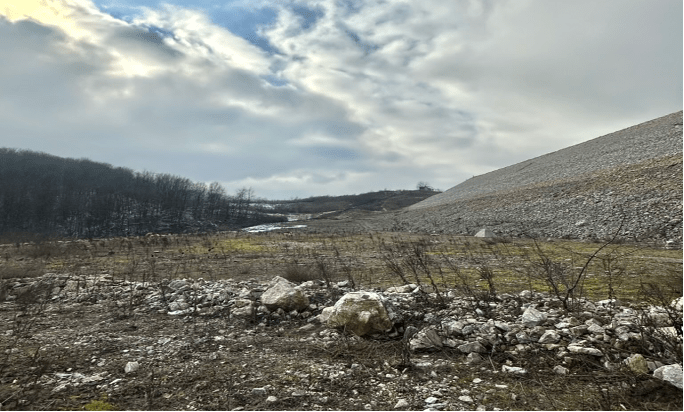
We continued north from Petkovici to Pilica, to visit the infamous Pilica Culture Center (Dom Kulture Pilica). There, on July 16, 1995, VRS soldiers killed around 500 Bosnian Muslims. Concerted efforts have been made to lessen the visibility of the atrocities in Pilica. When the Srebrenica Memorial Center sought to film inside the facility, where scars of the genocide are still visible, the authorities issued a ban on filming. Other times, those visiting the Culture Center for research have been asked to leave by police. We parked across the street and stayed in our vehicle.
Notably, like many of the other sites used by Bosnian Serbs to kill and conceal the Srebrenica genocide, nothing marks the mass killings at the Culture Center. However, positioned in front of the Culture Center is large monument to soldiers of the VRS, the genocide’s perpetrators. At Pilica, the consistent, perhaps paradoxical use of memorialization to advance atrocity denial came into stark physical form.
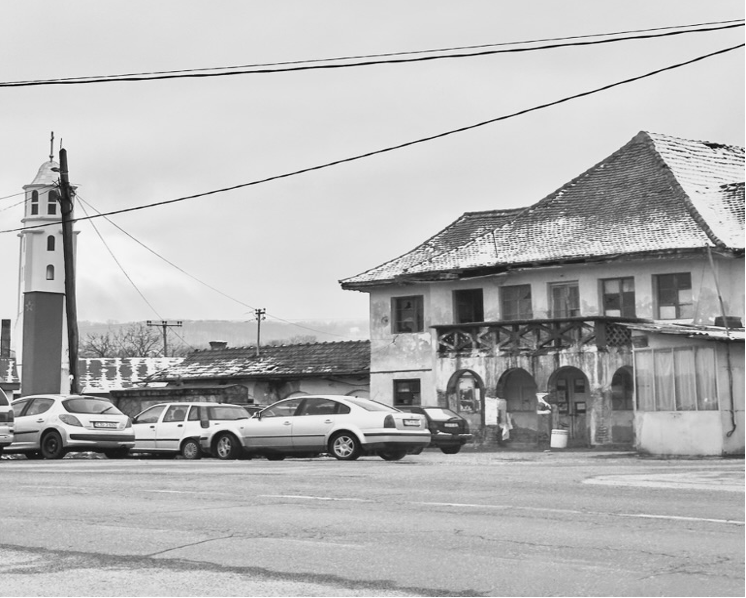
Having now seen three significant execution sites, the final stops of our day navigating the treacherous historical terrain of Eastern Bosnia brought us to its mass graves. We departed Pilica for Kozluk, passing another mass grave site—the Branjevo Military Farm—on the way.
The Kozluk site was a primary mass grave. A worn, gravel road took us on the bumpy pathway from Kozluk’s small town center towards the Drina. The road practically ceased at the edge of the water. We stepped out of the car and walked a bit along the water. One of my guides surmised, in passing, that the River Drina itself is probably the largest mass grave in the country. After walking a brief minute or two, we came upon a large mass of land that appeared to be sinking—a cratering from the grave-digging that destabilized the land’s surface.
On this patch of land, 375 people were identified in three separate exhumation periods. Those uncovered “were found wearing civilian clothes” and a “large number of bodies [] had ligatures and blindfolds.” ICTY investigators had come upon the site during a 1998 visit to Eastern Bosnia. The investigators’ noticing of the altered soil sparked an extended exhumation processes which revealed the extensive grave.
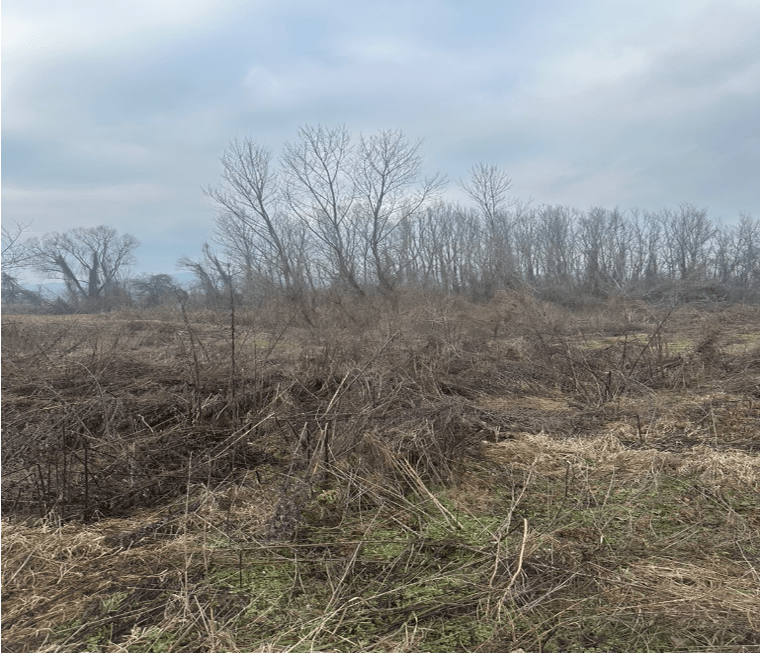
After Kozluk, as the sun began to set gradually, we began making our way back to Srebrenica. Our final stop was Čančari road in Kamenica, a long road winding path through sparse villages where several secondary mass graves were uncovered—including some graves which contained remains of those initially buried in Kozluk.
There are about thirteen graves that were discovered along the road, each marked by a plaque which details the quantity of victims discovered and the date of exhumation. Generally, per the Balkan Investigative Reporting Network’s database of mass graves, “[t]he gravesites in Kamenica were discovered either in the courtyards of houses which belonged to the Bosniaks, or in meadows next to the road.” The presence of Bosniak returnees to these villages allowed for the erection of the pictured mnemonic stones.
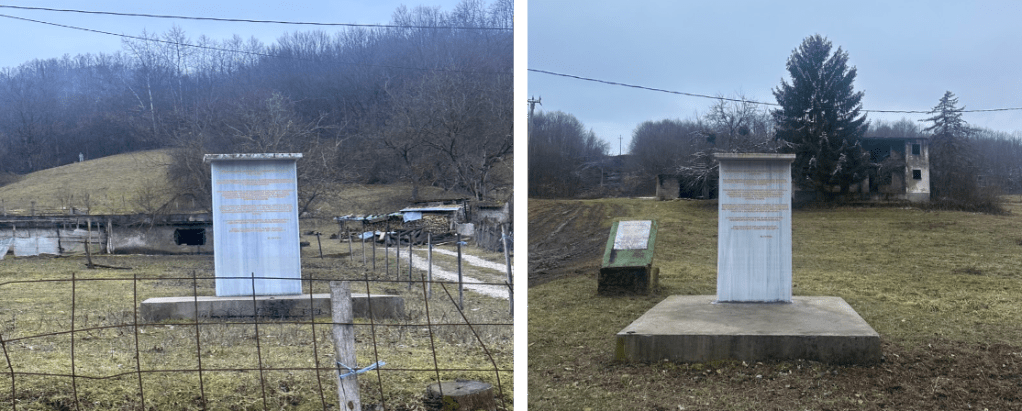
At the end of Kamenica’s seemingly endless road of commemorative plaques, we concluded our day in Eastern Bosnia, turned around, and drove quietly back to Srebrenica. The genocide’s ongoing presence atop the landscape of Eastern Bosnia is profound, though this trip revealed that much of the sites of atrocity are invisible to the untrained eye. The absence of consistent memorialization—the concrete attempts to assimilate the genocide’s infrastructure into everyday life—render it difficult to recognize. In Eastern Bosnia, many residents live amongst the silences of 1995, though simultaneously, the rhetorics of Srebrenica denial and genocidaire glorification continue to grow.
What occurs when the work of international criminal law is passed onto the state and its people? When adjudication produces a set of allegedly unassailable truths about the past, can the mere sanctity of the courts and supposed legitimacy of their process effectively prevent subsequent denial? In Eastern Bosnia, I learned, the land itself answers many of these questions and provokes salient questions about the possibilities of criminal law and transitional justice.
Connecting this day to my larger body of work in Bosnia, I returned to my accommodations in Potočari pondering the purpose and function of memorialization. Certainly, between the extensive ICTY-established facts and varied efforts to communicate the underlying information to the public, there is no societal dearth of details about genocide in Eastern Bosnia. Yet, denial rampantly proceeds across much of the country, at some points morphing into more extreme forms of glorification and justification.
In this climate, then, is memorialization necessary as a prophylactic measure? Post-atrocity commemorative sites are often conceived as such: “spaces of memory are touted not only as honoring past victims, but also as important tools for preventing future violence.” But, as Ana Milošević warns, memorialization’s “profound promise” of prevention “often falls short.” Nonetheless, after traversing the Podrinje from Srebrenica to Kamenica, I cannot help but imagine that genocide denial—and the related dehumanization of Bosnian Muslims—would be a more difficult project if Srebrenica’s memory was etched visibly into daily life across Eastern Bosnia.
Ben Gerstein is a fellow at the University of Sarajevo Institute for Research of Crimes Against Humanity and International Law. All photographs in this essay are taken by the author. Follow Ben on Bluesky.

 legalsightseeing.com