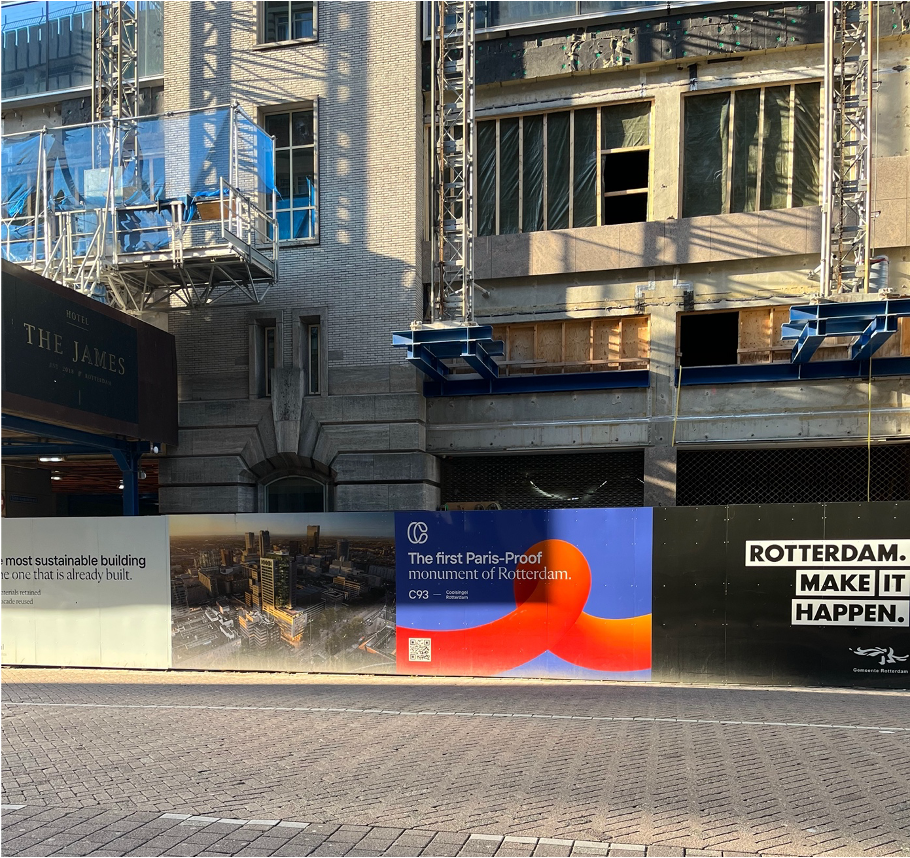
Walking through my hometown Rotterdam, I stumbled on a peculiar construction façade proudly announcing: ‘The first Paris-Proof monument of Rotterdam’. While my love for Rotterdam, its architecture and unique atmosphere in the Netherlands, cannot be overstated, a resonance to the Romantic allure and monumental identity of the City of Love seemed, even to me, slightly outrageous. The developers of the building of course had a different Paris in mind for their message – the Paris of the Paris Agreement. In 2016, this truly monumental legal document enshrined the goal of ‘Holding the increase of global average temperature to well below 2°C above pre-industrial levels and pursuing efforts to limit the temperature increase to 1.5°C above pre-industrial levels’ (Art. 2 Paris Agreement). The environmental claim of a ‘Paris-Proof monument’ incited a certain excitement in the lawyer within me (a side which I mostly do my best to hide outside of the classroom).
I want to flesh out the spotting of greenwashing as a form of legal sightseeing
Incidentally, or maybe precisely because, at the time I was teaching a course on misleading fossil fuel advertising designed by my colleague Clemens Kaupa at the Vrije Universiteit Amsterdam, the environmental claim stood out to me. In the course, we use misleading fossil fuel advertising as a case study to teach second year bachelor students the basics of EU law. When I took the picture, we were in the second week of the course which covered the effects of EU law (think: direct effect and legal primacy). To make the students understand these core EU law concepts, we looked at the Unfair Commercial Practices Directive (UCPD) and assessed whether this Directive could be a possible avenue to challenge misleading fossil fuel advertising. With the UCPD thoroughly on my mind, I saw the construction façade and the first thought that popped into my head was whether the claim of a ‘Paris-Proof Monument’ could be considered a misleading commercial practice. I will not bore you with the legal details that I confronted my students with in the tutorials. Rather, in this blog I want to flesh out the spotting of greenwashing as a form of legal sightseeing and what it tells us about the current climate predicament that we find ourselves in.
Additionally, the sustainability of the building only becomes relevant ‘during operation’. Seemingly, a ‘Paris-Proof’ building does not need to take into account the CO2 emitted during its (re)development. The building and construction sector ‘is by far the largest emitter of greenhouse gases, responsible for 37 per cent of the global emissions’. While most attention in this sector has been focused on reducing emission during operation (heating, electricity use, etc.), the reduction of emissions ‘embodied’ in the building materials has, according to the United Nations Environmental Programme, ‘lagged far behind’. It is exactly in this aspect that C93 could prove its ‘Paris-Proof’-ness considering it is a transformation rather than a construction. But again the website resorts to rather vague claims: ‘as much material as possible will be reused’. Where the website does get a little specific is when it sets out the addition of a ‘new top-up’, which is achieved by removing the ‘tower’s energy- and technically defaulted facade – consisting of 4-centimeter-thick slabs of Brazilian granite’. For those among us worried about the fate of the Brazilian granite, rest assured. This ‘granite will not be wasted: it will be crushed and processed into new, lighter slabs that will be used as cladding for a thickly insulate facade shell.’ As the purpose of removing the granite is its weight reduction, which allows for the extension at the top of the tower, the leftover granite needs to find its proper place too. Luckily the ‘rest of the facade will be incorporated into the interior’. Let it be precisely the deceptiveness, or façade, of the depicted interior that adds to my suspicion of greenwashing.
The European Commission’s notice guiding how the UCPD should be interpreted includes a section on environmental claims. Here it is made clear that ‘vague and general statements of environmental benefits’ are ‘likely to be misleading’. Additionally, ‘the imagery and overall product presentation’ can contribute to the extent that a certain commercial practice can be considered misleading.
Included on the architect’s website is a rendering of the inside of the building which depicts flourishing green balconies with plenty of natural light.
Included on the architect’s website is a rendering of the inside of the building which depicts flourishing green balconies with plenty of natural light. The before and after picture on the website similarly depicts plenty of green on building’s improved exterior. Whereas the before picture is conveniently a black and white picture, the after contains lively colors. Would this fall within the meaning of misleading ‘imagery and product placement’ that the Commission refers to in its guidance? I would say judge for yourself.
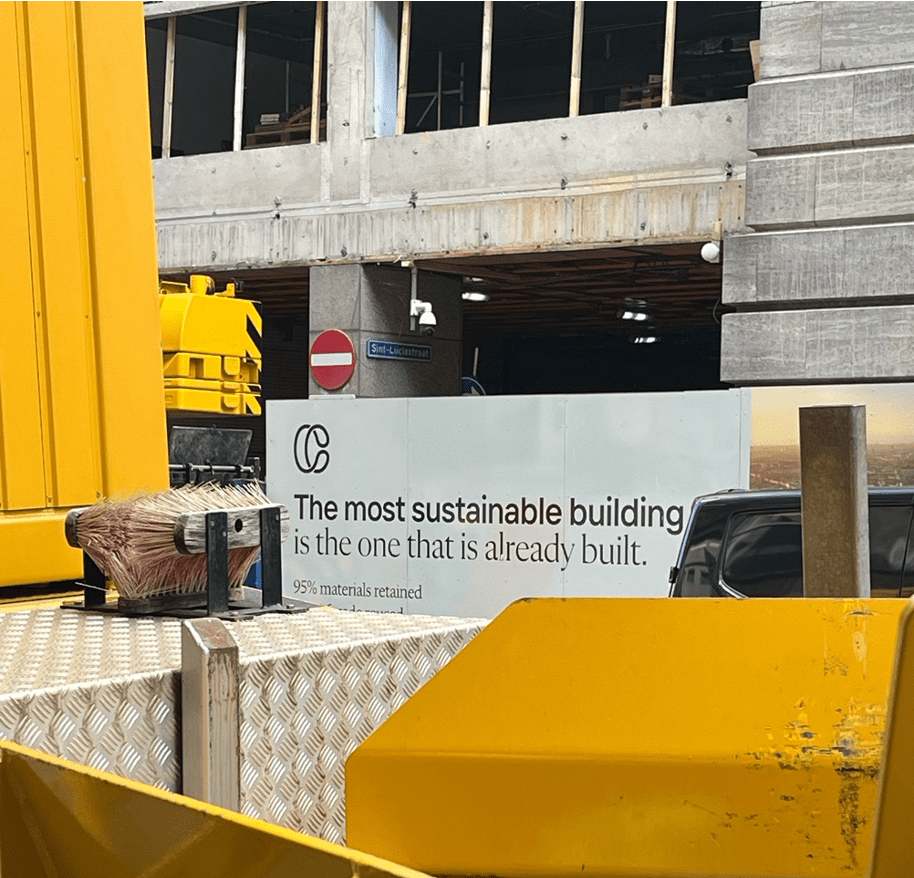
Ever since Stefano Boeri’s Bosco Verticale building in Milan, the world of urban architecture has been taken over by the so-called vertical forest trend. Simply put, this practice consists of including plants and trees in the construction of high-rises. In the Netherlands this trend has manifested itself in Utrecht (Wonderwoods), Eindhoven (Trudo Toren), and Amsterdam (Valley). A recent addition to this trend is planned to rise up in Rotterdam: Tree House. The environmental benefits of these green buildings have not been without scrutiny. But at least they look green! The Architecture firm behind the Valley, MVRDV, even composed an exhibition ‘Carbon Confessions’ where they contemplate their own contribution to the climate crisis. Part of this exhibition was an event called ‘Don’t keep building, keep THE building’. Interestingly, a similar statement is made on the construction façade of C93: ‘The most sustainable building is the one that is already built.’
So, what does it mean to keep a building? And does it also matter what a building is kept for? Maybe it stings me even more that in times of a housing crisis, where during the last elections almost all political parties in the Netherlands seemed to emphasize ‘bouwen, bouwen, bouwen’ (build, build, build), that the sustainable practice of keeping a building is just for the purpose of another office building. Adding insult to injury, somewhere down the street of C93, a perfectly well-functioning, and frankly beautiful if you ask me, social housing unit Pompenburg is to be demolished to give rise to three enormous new towers.
The development of C93 will transform the tower from 26,000m2 office space to 30,000m2. On the website of real estate developer Provast, it is announced that ABN AMRO will be one of the new renters of C93. Precisely this bank has recently explicitly backtracked their climate ambition by updating their ‘Climate Plan to align with a well-below 2-degree pathway’. Seemingly, thereby making clear that they let go of the effort to limit global warming to 1.5°C, as also noted by Donald Pols (director of Milieudefensie). A sustainable building housing a not-so-sustainable bank seems to confirm my inclination that most environmental claims are empty shells. It is ironic that C93 for a time used to be a literal empty shell.
The building was original commissioned in 1946 by the Amsterdamsche Bank (which together with the Rotterdamsche Bank fused into the AMRO Bank, which in 2010 turned into ABN AMRO). When the concrete structure was finished in 1949 the development project was abandoned, leaving behind nothing but a concrete skeleton. It seems that ABN AMRO has stayed true to its historical self by abandoning its climate ambitions in a similar fashion. For three years the unfinished building had a prominent place in the middle of Rotterdam’s most famous street: the Coolsingel. This concrete skeleton was by many considered a stain on the success story of rebuilding the city after it was bomb to the ground in WW2. Only in 1952 when it was sold to the Bank voor Handel en Scheepvaart (Bank for Trade and Shipping), was the building finished and came to be known as ‘De Bank voor Handel en Scheepvaart’. Maybe it is just me but these days encountering an empty concrete structure often seems more hopeful than another shiny office building – certainly when the office is inhabited by bankers and the like. Just think of the beautiful vertical gardens that the concrete skeleton could have housed or, even more so, the possibility to develop housing for actual people.
The assertion by the Architecture firm that ‘the soul of the original tower is preserved’ takes on an ironic double meaning. Of course, what they refer to is the preservation of characteristic traits of the building (which received monumental status in 2024). However, in retaining the soul of the building, not merely its aesthetic exterior seems to be preserved but also the very logic of capitalism that was tied to the building in name and operational reality as De Bank voor Handel en Scheepvaart – mind you international trade (including maritime shipping) is still good for roughly 20-30% of global emissions. Renaming the building toC93, proclaiming it as a ‘Paris-Proof Monument’ while preserving the spirit of its former occupant by housing the likes of ABN AMRO, seems exemplary of the common rhetoric of green growth and sustainable development (both contradictio terminis, if you ask me). While the world is ever-closer to transgress the goal of limiting global warming to 1.5 degrees set in the Paris Agreement and scholarship is preparing itself for a post-1.5 world, ‘the first Paris-Proof monument of Rotterdam’, with its vague environmental claims, might be emblematic for the emptiness of our current climate ambition. Yet, seeing the sight of greenwashing, noticing its irony, might be just that what is needed to alter the ambivalence to climate action in current society – it certainly invigorated some outrage in me, hopefully you will follow suit!
Bent Bos is a PhD candidate and lecturer at VU Amsterdam. He researches the legal imaginaries of climate neutrality.